It’s gonna be one of those nights. A sleepless one that is. There are severe thunderstorm warnings out for the western part of the state and the string of storms is headed this way. Hoping it might fizzle out before it gets here. Just in case, we’ll unplug the rig and stow the cord before we go to bed. Our new friends, Dave and Susie Smeal sent us an article on lightning and RV’s, which was interesting reading. It’s a rather lengthy article but very important info so I’ve pasted it here, along with the credits of those who wrote it.
Lightning and Recreation Vehicles (RVs)
…treat lightning like a snake: if you see it or hear it take evasive measures…
The purpose of this paper is to acquaint the reader with lightning in general and the affect of lightning in particular on an RV. Many of the statements made in this article have been copied directly from the Internet site or homepage WEB pages of the National Lightning Safety Institute (NLSI). Other statements from referenced sources have been modified to relate to RVs. Others result from interviews or e-mails with people who have encountered lightning. The short version of the paper is If parked and a lightning storm is nearby, make sure the RV jacks are retracted and the shore power lines are disconnected and stored. Three examples of lightning detectors are provided.
Lightning has been known to strike more than 10 miles from a storm in an area of clear sky. There is no defense for lightning's bolt-out-of-the-blue occasional strike. But for the most part, lightning safety is a risk management procedure. Early recognition of the lightning hazard, with an awareness of defensive options, will provide high levels of safety. The frequency of lightning increases in the lower latitudes (closer to the equator), and in the higher altitudes (mountainous terrain). In the USA, central Florida experiences some 10-15 lightning strikes per sq. km./yr. Over the entire year, the highest frequency of cloud-to-ground lightning is in Florida between Tampa and Orlando. This is due to the presence, on many days during the year, of large moisture content in the atmosphere at low levels (below 5,000 feet), as well as high surface temperatures that produce strong sea breezes along the Florida coasts. The Rocky Mountain west has about two-thirds this activity. Half of the casualties of lightning strikes occur in open fields. The most common situation for a lightning death or injury in Florida was found NOT to be in the heaviest rain area with lots of flashes, but after or before the time when rain and lightning was the most intense. Essentially, the most dangerous times occur from a weak storm without too many flashes, at the edge of a larger storm, or early or late in the life of a storm. Much of a storm's lightning remains within the clouds, leaping from the negatively charged bottom of the clouds to the positively charged top. When an object on the ground, such as a tree, building or an RV, becomes positively charged, the lightning sparks to the ground. A bolt of lightning can be as great as 15 million volts.
Lightning leaders from thunderclouds proceed in steps of tens of meters, electrifying ground-based objects as they approach the earth. Ground-based objects may launch lightning streamers to meet these leaders. Streamers may be heard (some say they sound like bacon frying) and seen (we may notice our hair standing on end). A connecting leader-streamer results in a closed circuit cloud-to-ground lightning flash. Thunder is the acoustic shock wave from the electrical discharge. Thus, thunder and lightning are associated with one another. According to a NASA study, men are struck by lightning four times more often than women.
Flash/Bang. Sound travels at about 1,100 feet per second. We all possess a first-class lightning detection device, built into our heads as standard equipment. By referencing the time in seconds from seeing the lightning (the FLASH, or F) to hearing the accompanying thunder (the BANG, or B), we can range lightning's distance. An F to B of five seconds equals lightning distance being one mile away. An F to B of ten = two miles; an F to B of twenty = four miles; an F to B of thirty = six miles; etc.
New information shows successive, sequential lightning strikes (distances from Strike 1 to Strike 2 to Strike 3) can be some 6 to 8 miles apart. Taking immediate defensive actions is recommended when lightning is indicated within 6 to 8 miles. The next strike could be close enough to be an immediate and severe threat. Lightning is a capricious and random event. Lightning cannot be accurately predicted. Lightning cannot be prevented. Lightning, however, can be detected. Advanced planning in the form of a risk management plan is the best defense for maximum safety. According to the NLSI, common misconceptions and myths include:
Rubber tires or a foam pad will insulate me from lightning… it takes about 10,000 volts to create a one-inch spark. Lightning has millions of volts and easily can jump 10-20 feet.
Lightning never strikes twice… it strikes the Empire State Building in NYC some 22-25 times per year !
Recreation Vehicles and Lightning What happens when lightning strikes a recreation vehicle? The answer, gleaned from anecdotal observations, is all the way from "nothing" to "Wow ! What a mess. . . my RV is a disaster." I have determined that few, if any, RVs get struck while mobile. They are mostly vulnerable when connected to shore power and/or when they have their jacks deployed without at least five inches of wood or some other insulator between the jacks and ground. I have noted that RVs are more susceptible to damage from induced lightning surges when connected to shore power and lightning hits nearby transformers. According to the NLSI, lightning's median amplitude is assumed to be about 20,000 Amps. Typically, a metal plate 3/16 inch thick will not be penetrated by that high of a current.
Electrically speaking, at lightning's higher frequencies, currents are carried mostly on the outside of conducting objects. A thick copper wire or a hollow-wall metal pipe will carry most of the lightning on outer surfaces. This phenomenon is called Skin Effect. The same holds true for lightning striking a metal vehicle (a vehicle with a solid metal roof and metal sides): the outer surface carries most of the electricity. The persons inside this steel box are partially protected by a partial Faraday Cage. But, some recreation vehicles do not have a surrounding metal cage. If an RV is manufactured of fiberglass, a direct lightning strike will likely go right through the vehicle, even if the vehicle body does not conduct electricity. Wet surfaces alter the current path. One of the most dangerous places is just outside of a vehicle, because electric current travels around the outside of vehicles.
Consistent with lightning's capricious nature, situations alter results. Are the RV jacks deployed directly on the ground? Is your generator on? Both of these situations increase your chance to attract lightning. If the RV is made of fiberglass (a poor conductor), Skin Effect principles may not work. On a 30 or 50-amp shore power cord, the connector connects the RV frame ground to the shore power earth ground. This path is designed to prevent an electrical shock from touching an electrical enclosure. The power cable will not provide a sufficient conductor to ground in the event of a lightning strike to the RV frame. There are devices available to help absorb some of lightning's tremendous energy by putting MOVs (Metal Oxide Varistor) from each line to common, but there is no sure fire, 100% safeguard for lightning. If you are in a severe storm the best protection is to lift your jacks and unplug. You may run some risk of personal injury as you are exposed while you are unplugging. According to Richard Kithil of the National Lightning Safety Institute, most reports of the economic impact of lightning are contradictory and underreported. I could not find a paper or study on lightning and RVs.
The Ground Fault Circuit Interrupter (GFCI) Circuit Breaker Field Study, sponsored by the Leviton Institute, reviewed data from 13,380 building inspections and found 15 %, on average, of GFCIs were inoperative when tested. The study looked at both GFCI circuit breakers and GFCI receptacles, and found similar failure rates for each. The data suggested that lightning strikes are one likely culprit in many inoperative GFCIs. The study found a much higher incidence of failure in areas where lightning is prevalent. In those regions, as many as 58 percent of GFCIs were found to be inoperative.
Reported damage to vehicles includes pitting, arcing, burning on both exterior and interior places. Cases have been reported of total destruction of vehicle wiring, and associated electrical and electronic systems. Police department reports include bad burns to the hands and mouth where officers were using radio microphones when their vehicles were struck. Cases describe total blowout of all four tires in passenger cars. However, a video in the National Lightning Safety Institute library shows a station wagon being struck by lightning in a heavy rainstorm, with no damage whatsoever occurring.
Some general recommendations for RV users include: If parked, make sure the RV jacks are retracted and the shore power lines are stored and disconnected. Do not store your power cable under your RV. Retract and store all deployed antenna. Disconnect external TV/Satellite antenna wiring. Reported incidents and related injuries make it clear that a person inside a fully enclosed metal vehicle must not be touching metallic objects connected to the outside of the vehicle. Door and window handles, radio dials, CB microphones, gearshifts, steering wheels and other inside-to-outside metal objects should be left alone during close-in lightning events. I suggest pulling off to the side of the road in a safe manner, turning on the emergency blinkers, turning off the engine, putting one's hands in one's lap, and waiting out the storm. Do not wash hands or take a shower during a storm. Do not get close to electrical appliances such as the TV or plug in laptop PCs. In no circumstances, during close-in lightning, should the passengers attempt to step off the RV to the ground in an attempt to find another shelter. Very dangerous Step Voltage and Touch Voltage situations are created when a "dual pathway to ground" is created. Lightning voltages will attempt to
equalize and they may go through a person in order to do so. Do not get on the roof of your RV when a storm is nearby! Don't be an isolated tall object, and don't be connected to anything that may be an isolated tall object.
To further lower your odds, don't park your RV near the tallest trees or utility poles. Rubber tires provide zero safety from lightning. After all, lightning has traveled for miles through the sky: four or five inches of rubber are no insulation whatsoever. People should get into a safe shelter. If not possible, make sure all windows are closed and the "hands on laps" rule is observed. If you can't get to a safer location, avoid the most dangerous locations and activities. Avoid higher elevations, wide-open areas, tall isolated objects, and water-related activities. Avoid unprotected open structures like picnic pavilions, and rain shelters.
An open-framed vehicle, which includes most RVs, does not count as a lightning shelter. If lightning is imminent, it will often give a few seconds of warning: hair standing up, tingling skin, light metal objects vibrating, seeing corona discharge, and/or hearing a crackling or "kee-kee" sound. The recommended body position is to immediately get into the fetal position. A vehicle with a metal roof provides good shelter, and is much better than being in the open or in an ungrounded building, but the vehicle is not as good as being in a building that is grounded by wires and pipes.
One case history included the following information: "Our lightning strike came through the campground fuse box (we were #1 next to the box) via the local sub station that got the direct strike. The surge may have gone to ground from the battery rack or through the frame to the hydraulic jacks. The coach batteries were totally discharged, the charger was fried and a 115-volt line to the cab area shorted out against the frame. I don't think the batteries were boiled dry. When the charger failed the surge must have gone directly to ground and quickly discharged the six coach batteries. The chassis batteries still had a charge and I was able to shunt power to the inverter via the dash switch." Another case history noted that an RV was plugged into a house when a nearby power pole was struck. Many electrical appliances in the house were totaled by the surge into the house, but the RV, which had a power surge protection device, suffered no damage.
People, who have been struck by lightning, do not carry an electrical charge and are safe to handle. All deaths from lightning are from cardiac arrest or a shock to the body that caused breathing to stop. CPR or mouth-to-mouth-resuscitation is the recommended first aid. Apply first aid immediately if you are qualified to do so. Get emergency help promptly. A textbook response to someone caught away from shelter is to assume the lightning position by squatting down with your feet together (toes touching) or on top of each other as well as you can balance without becoming prone and spread out your group. Do not lie down. Avoid metal objects. The 30/30 rule is that if it takes 30 seconds or less between flash and the sound of thunder, then seek shelter and remain for 30 minutes after the last occurrence of lightning. The largest occasions of fatalities are in or near the water. The next category is under trees.
Detector Examples
• The Boltek LD-250 Lightning Detector ($800) puts a live lightning map on a laptop or desktop computer. This system would be applicable for commercial and government campgrounds or RV rally sites. Within milliseconds of a lightning strike, the detector beeps and your computer displays the strike location. The LD-250's direction-finding remote antenna measures lightning strike direction while the receiver estimates distance from received signal strength. Advanced signal processing in software improves distance accuracy, reducing the effects of strike-to-strike variations in strike energy. The LD-250 can warn of both close and severe thunderstorms. If a storm is detected closer than a preset distance or the strike rate exceeds a preset limit, the LD-250 sounds an internal alarm and activates the computers alarm tone or WAV file notification. Both the Close Storm and Severe Storm alarm status indicators are on the front panel. The LD-250 uses a small active antenna to receive the radio signals from lightning strikes. These signals are the crackling you hear on an AM radio during a thunderstorm. The direction-finding antenna is able to tell which direction the signal is coming from. The software measures the strength of the received signals to estimate distance. Special signal processing in software reduces the effects of strike-to-strike energy variations providing more accurate distance information. For mobile installations, generator electrical power is required and the antenna needs to be mounted on the roof of the vehicle.
• The SkyScan Lightning /Storm Detector ($190) provides an indication of the level of activity of the storm. This device could be used by individual RV owners and mounted on the vehicle. The device determines if the storm is moving towards, away or parallel to your position. Each time SkyScan detects a lightning stroke, the sensor emits an audible warning tone and lights a range indicator.
• StrikeAlert, by Outdoors Technologies, ($80) provides an early warning of approaching lightning strikes from as far away as 40 miles and indicates if the storm is coming. The detector is perfect for an individual for outdoor sporting events and activities. An audible alarm sounds when there's a strike and a corresponding LED light illuminates accordingly at lightning distances of 20-40 miles, 12-24 miles, 6-12 miles and within 6 miles. The detector is housed in a small pager-like casing that can be clipped on a belt loop and runs on a single AA battery.
I assume no responsibility for weather hazards or lightning detectors and provide this disclaimer as a reminder that you should follow good safety practices.
Sources:
The Outdoor Network , Lightning Safety for Outdoor Adventure/Recreation, vol ix, no.2, 1999 (Summer 1998)
National Lightning Safety Institute (NLSI)
National Severe Storms Laboratory, NOAA
Science at NASA, Human Voltage
http://www.struckbylightning.org/
John McHale Date Reviewed: 9/1/05
Thanks to our friends, Dave and Susie for sharing this info with us. Bobbie and Jim made the introductions to us and we made contact last week. They came out Sunday afternoon and we had a wonderful chat and dinner. It’s so neat to make new friends on the road and getting to re-connect with them as we make our loop around the country. One of the many wonderful perks of this nomadic life of ours.


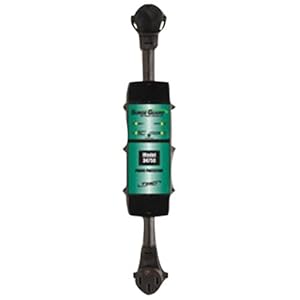 I don’t remember if I had mentioned in a previous post that last Tuesday we purchased a portable surge guard, while we were at Camping World waiting for our microwave to get checked out. A neighbor of ours, in the 30 amp section of the campground, told me that there is quite a bit of “dirty power” here in the park and that concerned me. We’ve been lucky for the five years we’ve been on the road but figured that since the converter was being replaced, that we want the best chance of keeping our electronic items intact. Hence, our purchase…and they were on sale at Camping World so it eased the bite a little bit. But, based on the article I posted last night,a lightening strike to the ground around us could still do damage so we disconnected from the pedestal, stowed the cord and went to bed.


